
In the first verse of the Ofudesaki, God tells us that we do not understand the mune. Tenrikyo church Headquarter translates and interprets mune as God’s mind. Yes, this could be correct, that we do not know God’s mind. I don’t think God is telling us that we do not know our physical heart that pumps our blood. Then what is the mune that God continuously tells us in the Ofudesaki that we do not understand? Could the mune be our own soul?
The Ofudesaki is written in a waka style of poetry where each line has a certain amount of syllables. The first line has (5) (7) (5). The second line has (7) (7). For example the first verse of the Ofudesaki is written like this
5 7 5
(Yorozuyo no) (sekai ichiretsu) (miharasedo)
(mune no wakarita) (mono wa nai kara) 1-1
7. 7
This style of poetry makes it difficult to place words that have more than 2 syllables. Tamajii (soul) has four syllables, and would be difficult to place in a verse of waka poetry. This is why instead of placing the word tamahii, God substitutes it with the word mune which only has two syllables. Mune or heart is translated as spirit or soul in some Japanese dictionaries.
My question to the Tenrikyo congregation is, if we cannot understand the word mune in the first verse of the Ofudesaki, how can we understand God’s teachings, and spread it to others? To the congregation, I challenge you to subsitute the word soul where the word mune is used in the Ofudesaki. It will make it easier to understand our own soul, and what it does.
おふでさきの最初の節で、神様は私たちに「むね」が分からないとおっしゃいます。 天理教教会本部は「むね」を「神の心」と訳し、解釈している。たしかに、私たちは神の心を知らないというのは正しいかもしれない。血液を送り出す肉体の心臓がわからないと神が言っているのではないと思う。では、おふでさきで神が私たちにわからないと言い続けている「むね」とは何だろう。ムネとは私たち自身の魂のことだろうか。
おふでさきは、一行ごとに音節が決まっている和歌のスタイルで書かれている。一行目は(5)(7)(5)。二行目は(7)(7)。例えば、おふでさきの一節目は次のように書かれている。
5 7 5
(よろづよの)(せかいいちれつ)(みはらせど)
(むねのわたりた)(ものはないから)1-1
7 7
この詩型では、2音節以上の単語を配置するのが難しい。魂(たましい)」は4音節あり、和歌の一節には置きにくい。 そのため、神はタマヒイという言葉を置く代わりに、2音節しかないムネという言葉で代用したのである。日本語の辞書によっては、「むね」または「こころ」は、精神または魂と訳されている。
天理教の信徒の皆さんにお聞きしたいのは、おふでさきの最初の節にある「むね」という言葉を理解できないのであれば、どうして神の教えを理解し、他の人々に広めることができるでしょうか。 信徒の皆さん、おふでさきの「むね」の部分を「魂」に置き換えてみてください。そうすることで、私たち自身の魂、そして魂が何をするのかを理解しやすくなるでしょう。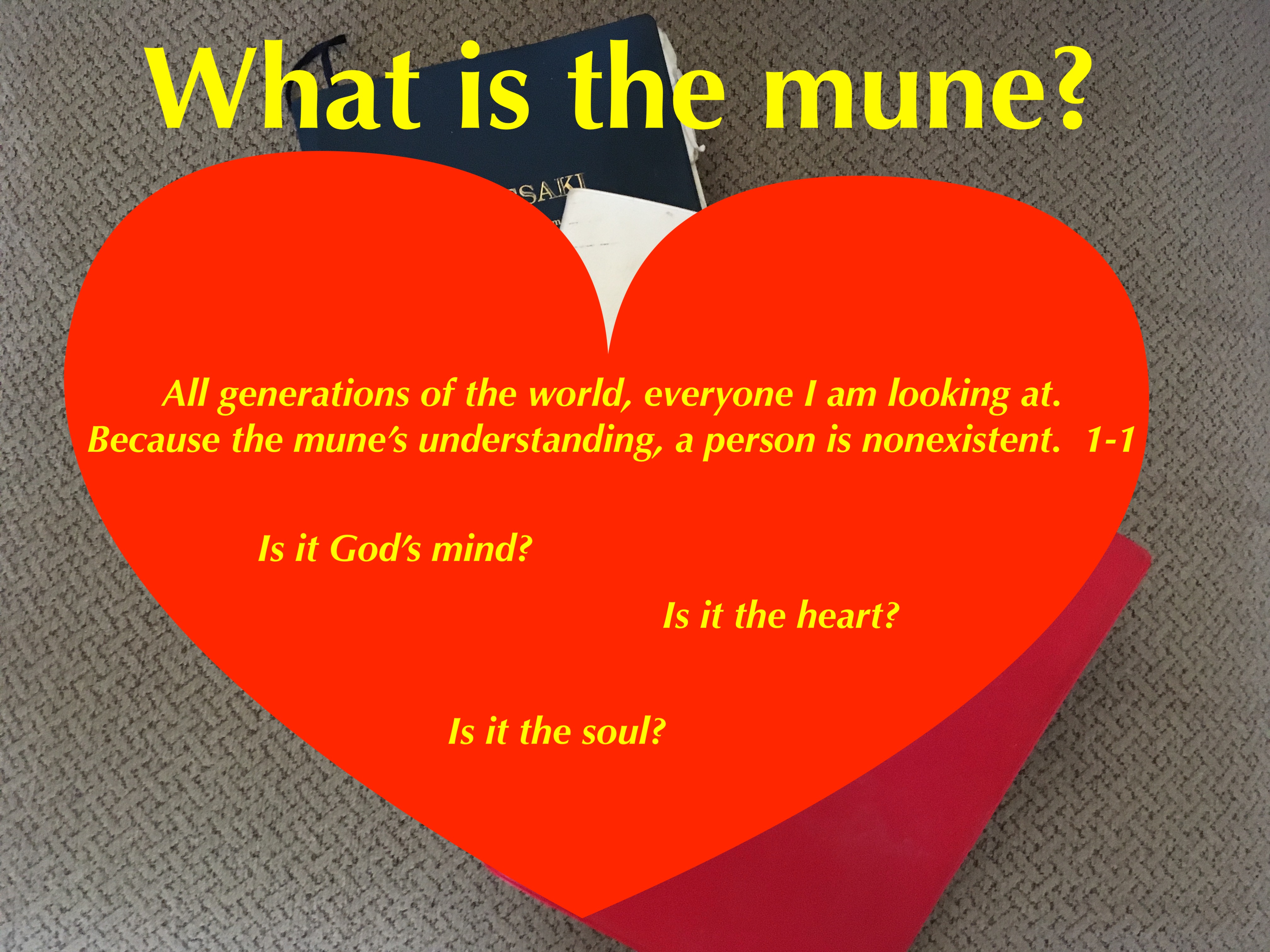

 OFUDESAKI-GOD'S TEACHINGS