
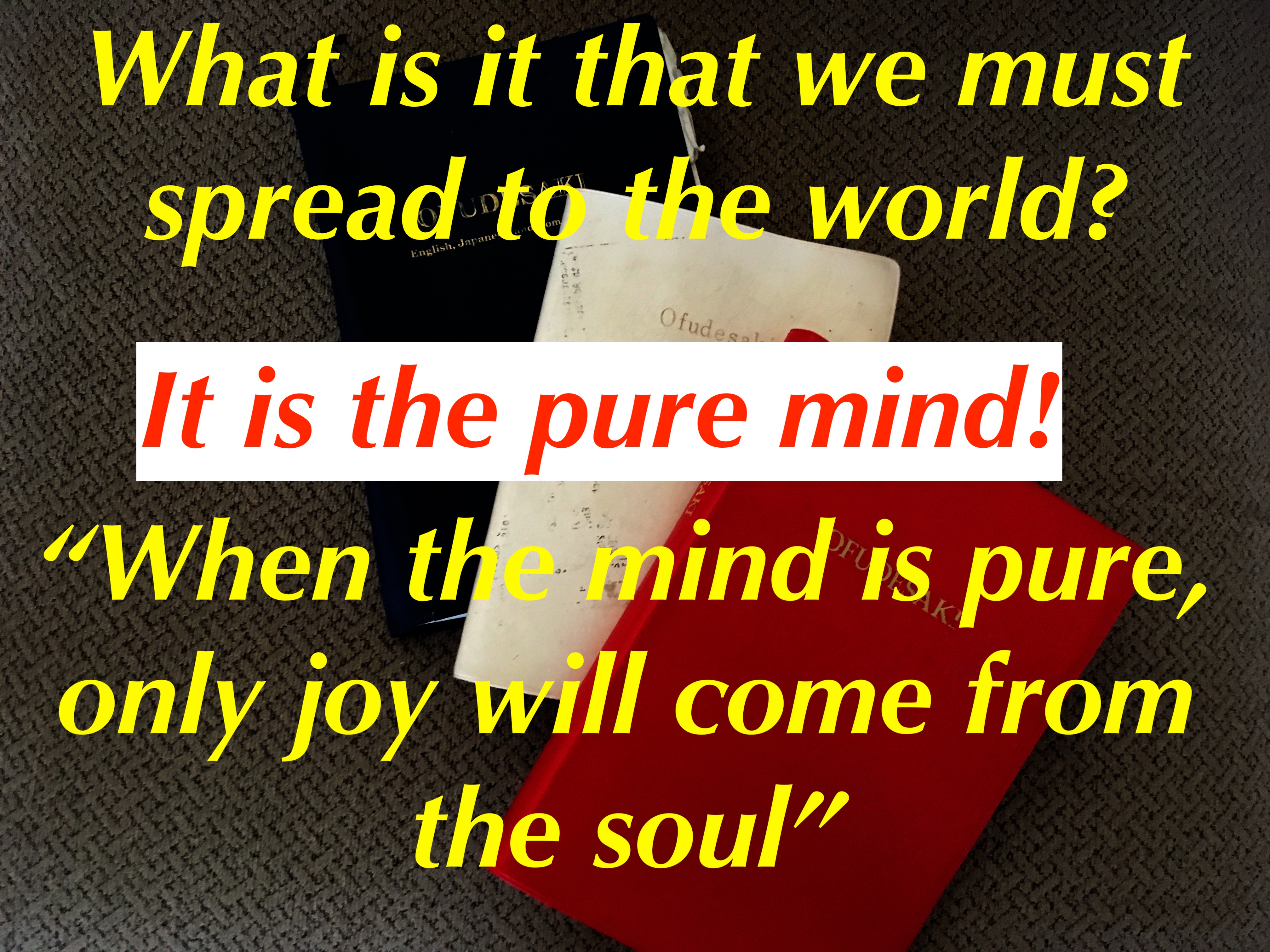

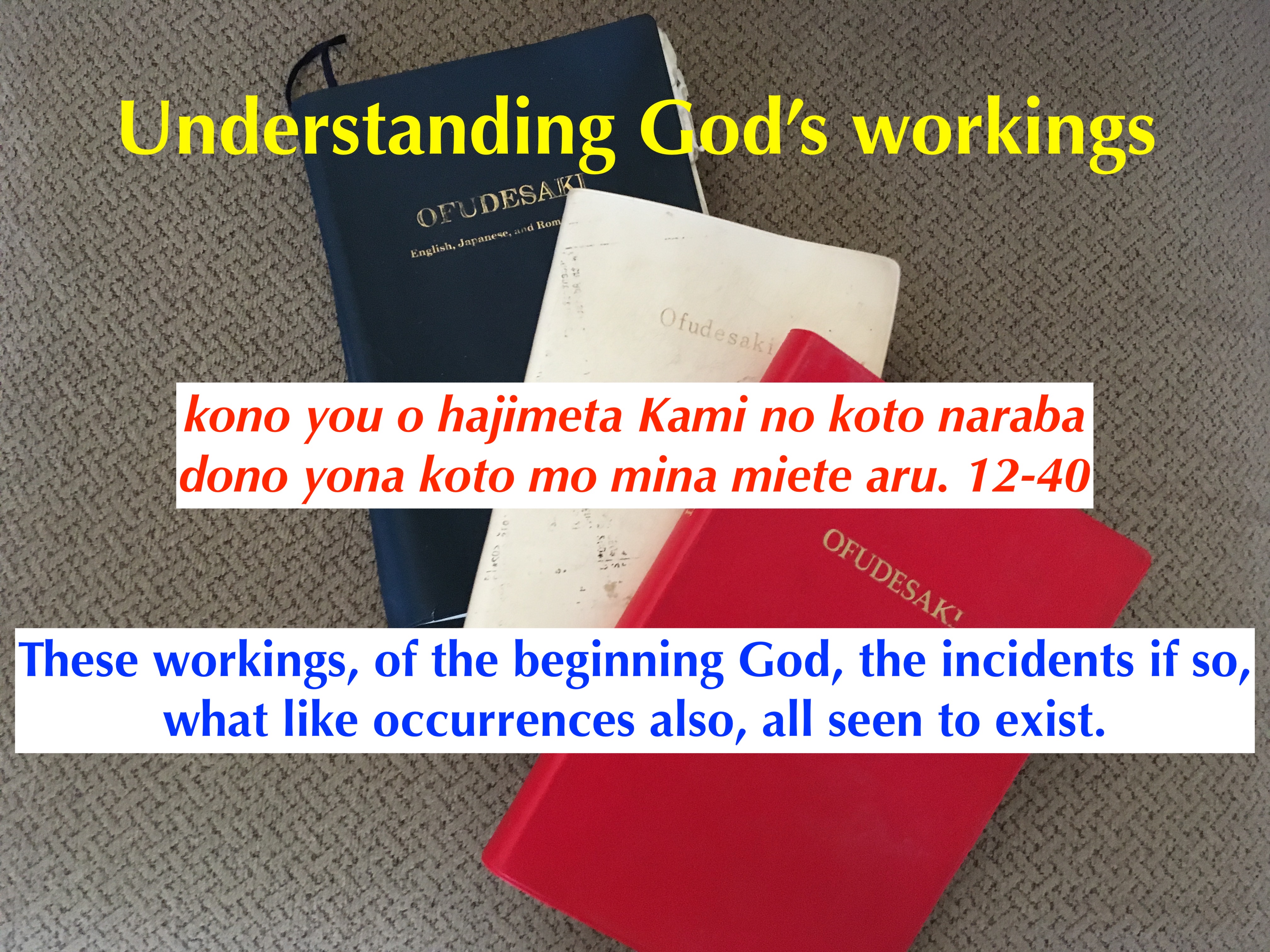
The Pure mind
Understanding and Removing Negative Thoughts: A Closer Look Through the Ofudesaki
In the Ofudesaki, God tells us to remove our negative thoughts. When our minds become pure, only joy will arise from our own souls, and we will feel spirited and full of life.
But as simple as that sounds, it’s not always easy to do. Let me explain with an analogy.
The Mind as a Painting
Imagine standing in front of a beautiful, intricate painting. At first glance, you may feel moved by its beauty, but you may not immediately understand what the artist intended to express. To uncover the painter’s true objective, you must study each part carefully, analyzing color, texture, composition, and symbolism—until the full meaning begins to emerge.
In the same way, God tells us to remove our negative thoughts. We may understand the general idea of what negative thoughts are, but it’s not always clear how to identify them in our own minds, especially when they are subtle, deeply rooted, or disguised as “normal” thinking.
Words Alone Are Not Always Enough
Often, hearing or reading “remove negative thoughts” is not enough to truly transform our thinking or behavior. Words alone may not give us the inner clarity or motivation needed to recognize what we are holding on to. That’s why we must take the time to examine our own thoughts carefully—like analyzing a painting—so that we can recognize, name, and release the ones that cause suffering.
So What Are These Negative Thoughts?
Let us now take a closer look at the specific negative thoughts that God wants us to remove, as revealed in the Ofudesaki. These thoughts are the “dusts of the mind” that cloud our spiritual clarity and cause suffering both to ourselves and others.
By naming them and understanding how they appear in daily life, we can begin the real process of purification—one step at a time.
The Dusts of the Mind (From the Ofudesaki)
Regret (oshii):
This is the feeling of being disappointed in others.
How often does regret arise in our daily lives?
Regret toward a spouse, children, or coworkers?
We must remember: everyone makes mistakes.
This feeling of regret is one of the dusts of the mind that we must work to remove.
Covetousness (hoshii):
This is the strong desire for a person or thing.
Often, this desire comes at the cost of others’ feelings.
Sometimes, people even hurt others in the process of trying to get what they want.
This is another form of dust that clouds our minds.
Self-love (kawaii):
This is the tendency to think only about oneself,
as if the world revolves around you, while forgetting the existence and feelings of others.
It’s a form of self-centeredness that blinds us to those around us.
Greed (yoku):
This is the desire to have more than what is necessary.
It often leads people to seek material gain at the expense of others. Greed, too, leads the mind away from purity and toward suffering.
Arrogance (kouman):
This is the belief that you are superior to others,
leading to a mindset that finds fault in others.
But God reminds us clearly:
“All people are equal.”
We must never forget this truth.
Why Must We Remove These Thoughts?
In the Ofudesaki, God teaches us that:
When these thoughts are in our minds, we will eventually act upon them.
This is why it is so important to remove them completely.
When the mind becomes pure, only joy will come forth from our soul,
and we will be able to live the Joyous Life God intends for all of us.
Posted in Buddhist, Christian, Christianity, From God, God's truth, heaven's truth church, Hindu, karma, Ofudesaki, Original pure mind, Protestant, Religion, soul, sufferings, Tenrikyo, The five sins to avoid, Understand Your Soul
Tagged Buddhist, christianity, God, Hinduism, karma, Ofudesaki, reincarnation, soul, TENRIKYO
Leave a comment

Politics and God
True Justice and Compassion According to the Ofudesaki
Some people are feeling disappointed or even outraged by recent findings in a case involving high-level government corruption and allegations of child sexual abuse. Many wonder if justice will ever be served.
But in the Ofudesaki, God clearly tells us:
Justice always comes.
Even if people seem to get away with malicious acts for a time, it is our own soul that keeps track of all our actions. Eventually, we all reap what we have sown.
In fact, the Ofudesaki goes so far as to say that if the debts of our negative actions accumulate too much, we may even return in our next life as animals—such as cows or horses—as a form of karmic return.
But Do We Want These People to Suffer?
Absolutely not.
God tells us in the Ofudesaki that no one is inherently evil.
Rather, evil thoughts have become attached to people through the dust of the mind. These people are not our enemies. They are, like all of us, God’s beloved children.
And it is exactly for these people that the teachings of the Ofudesaki exist.
God wants to save them, just as God wants to save all of us.
When their minds become pure, they too can be saved.
This is the heart of Tenrikyo’s message: universal salvation through the purification of the mind and the understanding of the soul.
Want to Learn More?
If you’re seeking a deeper understanding of these teachings, I invite you to explore the following resources:
- 📘 Facebook: Ofudesaki Study Group
- 🌐 Website: heaventruth.com
- 📚 Books available on Amazon:
-
- The Ofudesaki (English translation)
- God’s Recipe for Health & Happiness
Together, let us learn how to purify our minds, understand our souls, and build a world based on health, happiness, and truth.
Posted in Tenrikyo
Leave a comment
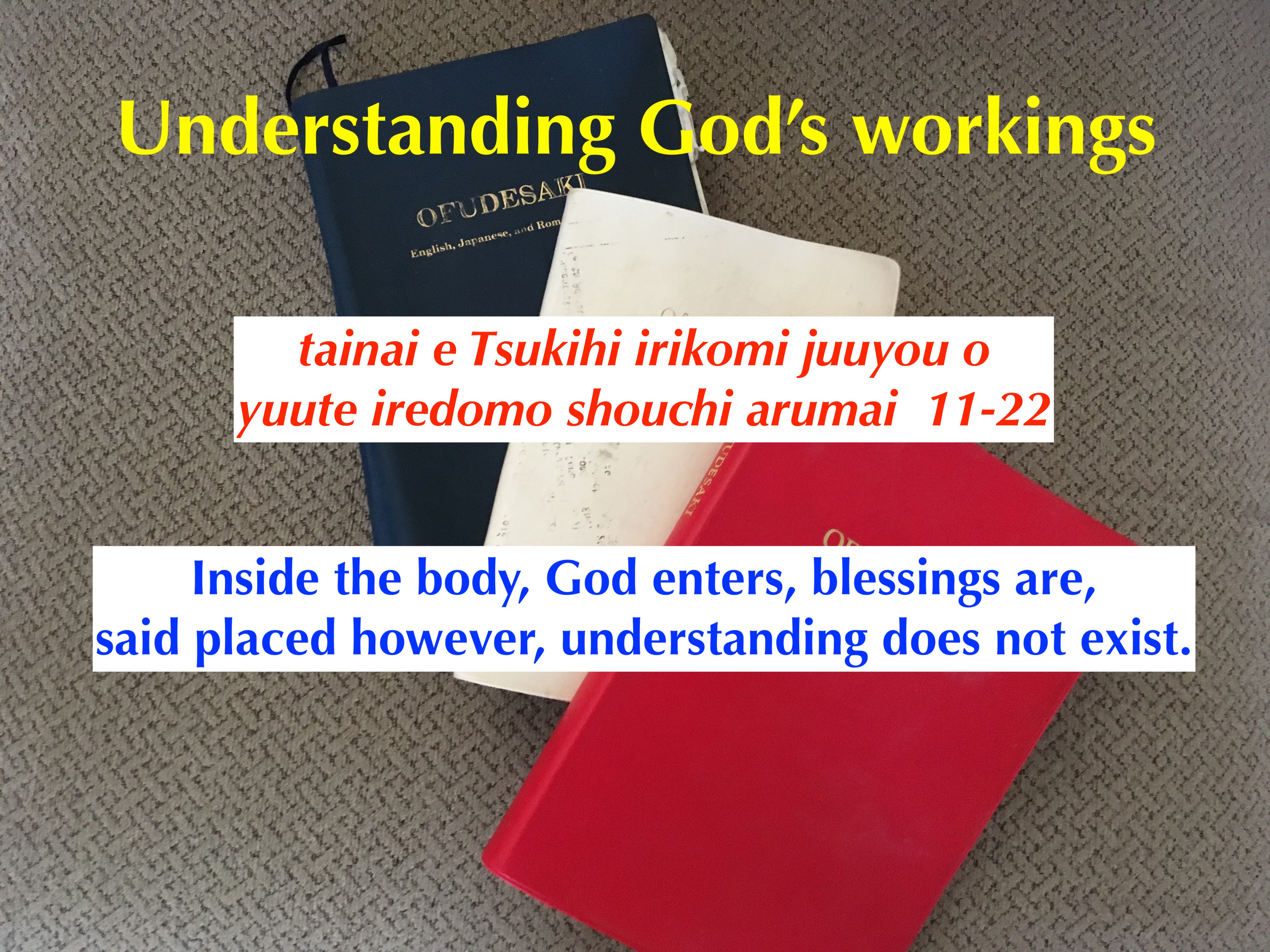

WE DO NOT UNDERSTAND THE OFUDESAKI
Understanding and Returning to the Core Teachings of the Ofudesaki
The message in the Ofudesaki is profoundly simple and clear: God desires that we attain a pure mind. This pure mind is one free of regret (oshii), covetousness (hoshii), self-love (kawaii), greed (yoku), and arrogance (kouman). When the mind is purified in this way, salvation is naturally received. From such a mind, only health, happiness, and joy arise—these are the workings of one’s own soul, as God teaches.
The Ofudesaki also guides us on how to share these teachings with the world. This is where the Youki-Tsutome plays a vital role. Through this prayer, we ask God to save the people to whom we have introduced the teachings. When God accepts our prayer, guidance may be given in the form of illness—not as punishment, but as a means for that person to come to understand the condition of their own soul. Through this process, they can begin purifying their own minds. This is how salvation spreads—not by force or numbers, but by each individual awakening to God’s truth.
However, it seems that today, some aspects of church leadership may have drifted away from the original intent of the Ofudesaki. If we are to fulfill God’s intention of world salvation, we must return to the foundational teachings—reading carefully, reflecting deeply, and aligning our practice with what is written.
This is not a criticism, but a heartfelt encouragement: that we all, together, renew our sincerity and strive to embody and spread the truth of the Ofudesaki. Only then can the teachings reach and resonate with the wider world.
おふでさきの教えは、非常にシンプルで明快です。親神様が望まれているのは、「心の浄化」です。すなわち、惜しい心(おしい)、欲しい心(ほしい)、かわいい心(かわいい)、欲(よく)、高慢(こうまん)といった心のほこりを取り除いた「すみきった心」に到達することです。健康やしあわせ、陽気ぐらしは、自らの魂の働きとして現れるのです。これは、親神様がおふでさきの中で教えてくださっています。
また、おふでさきでは、どのようにしてこの教えを世の中に広めるかも示されています。その要となるのが「よふきづとめ(陽気づとめ)」です。このおつとめは、私たちが教えを伝えた方々を、親神様にたすけていただくための願いそのものです。
すみきった心になることで人はたすかりますが、その人たちが心をすみきらせるように導くのが親神様のおはからいです。私たちの願いを親神様が受け取ってくださると、その方々に「病」を通じた「おしえ(さしづ)」が現れます。これは罰ではなく、自らの魂の働きを理解するための導きです。こうして人々が心を自ら浄めることに目覚めていくのです。これが、本来の意味での「教えの伝播」だと私は考えます。
しかしながら、現代の天理教の指導体制においては、このおふでさきのご指示が十分に実践されていないように感じられます。その結果として、私たちの信仰が世界の中でごく一部の人々にしか届いていないのではないでしょうか。
これは決して非難ではなく、私たち皆が心を合わせて、本来の教えにもう一度立ち返るための呼びかけです。おふでさきの教えを丁寧に読み、深く味わい、日々の実践に活かしていくことが、親神様の望まれる「世界たすけ」の実現につながると信じております。
Posted in Tenrikyo
Leave a comment
OFUDESAKI 11-14
When blessing of guidance appears on your body, you must understand why it appears.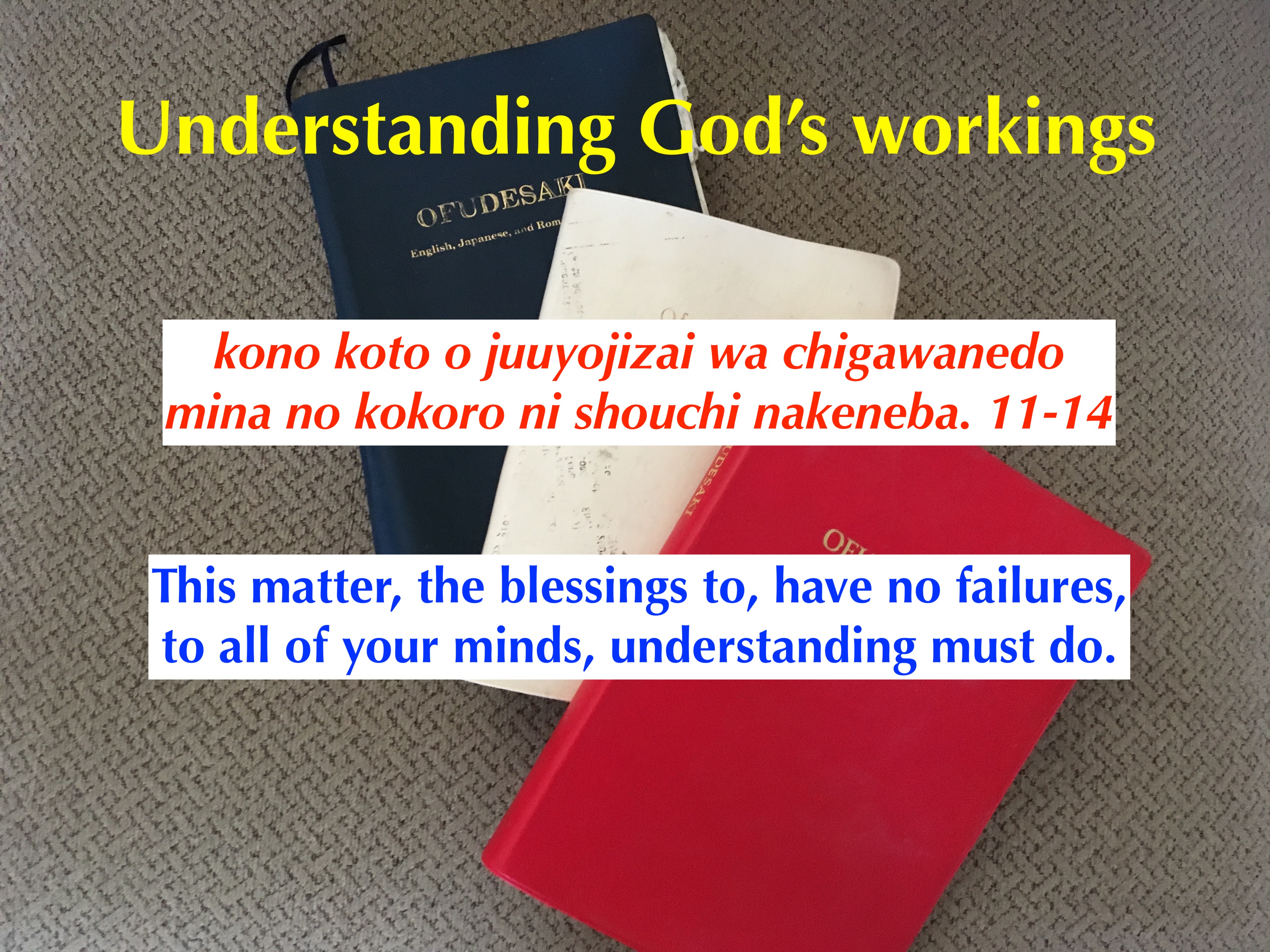
Posted in Tenrikyo
Leave a comment
 OFUDESAKI-GOD'S TEACHINGS